
The anti-TikTok symphony
Mahler’s Ninth Symphony runs for about eighty minutes. It opens quietly, with a hesitant heartbeat in the cellos, and it ends quieter still, the strings fading so gradually you can’t say exactly when the music stops. In between, it asks an audience to do the one thing our phones are designed to stop us doing: pay attention to a single thing for a long time.
I call it the anti-TikTok.
It’s also, to my mind, the summit of the symphonic repertoire, and it arrived at a hinge point in history. Mahler wrote it in 1909 and 1910, as the old empires of Europe, his own Austro-Hungarian Empire included, were coming apart. Within a few years that collapse would lead to the First World War, then the Second, and a century of destruction. Music was coming apart too. The tonal system Western composers had built on for three hundred years was about to give way to atonality. Mahler stood right at that crossroads and seems to have felt both fractures before almost anyone else. He was a kind of musical prophet.
Then there’s the man. I often say Mahler is the most emo of all composers, and he had reason. In 1907, in the space of a few months, his eldest daughter Maria died of scarlet fever and diphtheria at the age of four, he was diagnosed with the heart condition that would kill him, and after years of antisemitic attacks in the Viennese press he left the Vienna Court Opera for the Met and the New York Philharmonic. He was the most celebrated conductor in the world. By the time he was finishing the Ninth, his marriage was in trouble too.
He was also superstitious about the number nine. Beethoven, Schubert, Bruckner and Dvořák never got past their ninth symphonies, so after his Eighth he wrote Das Lied von der Erde and gave it no number. Then he wrote this one and called it his Ninth. He started a Tenth and died in May 1911, aged fifty, before he could finish it. He never heard the Ninth performed.
So yes, it’s a farewell. What strikes me every time is how much love there is in it, for life and for people. For a huge orchestra, it spends a lot of its time behaving like a chamber group. Near the end of the first movement, solo flute, horn, cellos and basses, and a solo violin wind around one another. Even when you get it perfectly together, it never sounds together. I think that’s the point.
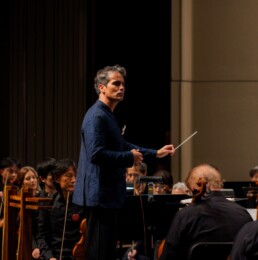
Conducting it is exhausting in a way little else is. In most big symphonies you grade the climaxes, holding something back so the biggest one lands. In this piece I don’t think you can. Every climax needs everything, from the orchestra and from me, and by the end none of us has anything left. Mahler uses the brass sparingly, so when the music has died away to almost nothing it can really explode. And in the last movement, after more than an hour, a single cymbal crash lands inside a string climax and seems to envelop the whole hall.
English is unusual in the word it uses for my job. The Italians say direttore, the French chef d’orchestre, and in Chinese it’s 指挥 (zhǐhuī), the word for command. They’re all about being in charge. “Conductor” is about energy, and I think that’s closer to what happens in a performance. We take the energy in the notes a composer left us, pass it through the orchestra to the audience, and the audience sends it back. You can feel when a hall is with you, and it changes how we play. Composer, musicians, audience. Great performances stand on that tripod.
By the finale, Mahler has put away the cynicism and doubt of the middle movements. What’s left is a man looking back on his life with enormous affection, for the people, the music, all of it. That’s why this symphony matters so much right now. It forces us to listen. It asks us to stay with a long thought and to see things in shades of grey rather than black and white, in nuance rather than sound bites. That’s the value of Mahler’s music, and of symphonic music in general.
My thanks to the musicians, who gave everything, and to Ted Jung, who made the film.